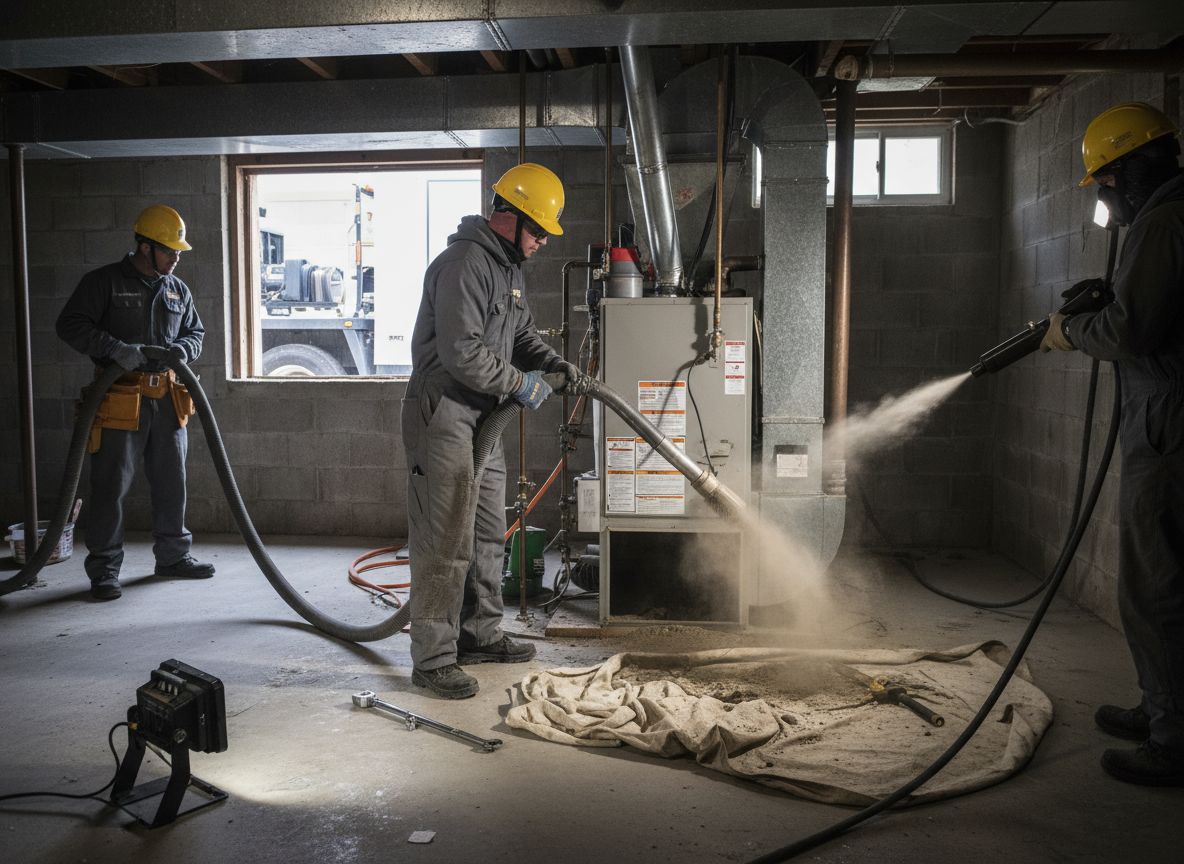
Montgomery homes built before 1970 often feature metal ductwork routed through crawl spaces or unconditioned attics where summer humidity condenses on cool surfaces. This leads to dust caking along seams and at register boots, restricting airflow and feeding mold growth during the long cooling season. Furnace and duct cleaning must include negative-pressure vacuuming from the furnace plenum outward while manually brushing each branch to break loose the compacted layer without dislodging insulation.
Edge cases appear in brick ranch homes near Court Square where original flex duct runs have sagged or kinked over decades. These sections trap debris that standard truck-mounted vacuums cannot reach, requiring sectional disassembly and handheld extraction tools. We also check the furnace blower compartment for pet hair and construction dust that re-circulates after every filter change, a common oversight in two-story homes on the east side of Montgomery.
Homeowners sometimes attempt DIY cleaning with shop vacuums attached to registers, which only pulls material from the first few feet and leaves the trunk line untouched. This creates pressure imbalances that push remaining dust into living areas once the system restarts. Proper cleaning requires sealing the entire system, using HEPA-filtered equipment rated for the volume of Montgomery’s typical 2,000–3,000 square foot residences, and verifying static pressure before and after service.
Technician insight
In Montgomery, the thing that catches most people out with furnace and duct cleaning is how the long humid summers drive condensation inside uninsulated ducts routed through crawl spaces of 1950s–1960s homes around Court Square. That moisture turns ordinary dust into a sticky layer that standard vacuums cannot pull without first breaking it loose by hand.
East Montgomery Ranch with Restricted Airflow
Homeowner reported weak airflow from several registers during summer. Inspection found sagging flex duct and heavy dust accumulation in the main trunk caused by years of attic humidity. We disassembled the affected sections, performed full negative-pressure brushing and extraction, then resealed the runs. Airflow readings returned to normal and the system no longer pushed visible dust after startup.
How it works
- 1
Initial System Inspection
We examine the furnace, return plenum, and all accessible ducts for damage, moisture stains, and insulation condition while noting any flex duct sags common in Montgomery crawl spaces.
- 2
System Isolation and Sealing
Registers are covered and the furnace is isolated so negative pressure can be applied without pulling contaminants from living spaces or the attic.
- 3
Mechanical Brushing and Vacuum Extraction
Rotating brushes agitate debris along each duct run while truck-mounted HEPA vacuum pulls material from the main trunk outward, addressing the compacted layers typical after years of humidity-driven accumulation.
- 4
Blower and Coil Cleaning
The furnace blower wheel and evaporator coil are cleaned to remove the fine dust that re-enters the airstream after every filter change in older Montgomery systems.
- 5
Final Pressure and Airflow Verification
Static pressure readings are taken before and after to confirm restored airflow, then registers are reopened and the system is run to check for any remaining issues.
Pricing
Pricing varies by home size, number of stories, and duct accessibility; we provide upfront quotes after inspection.