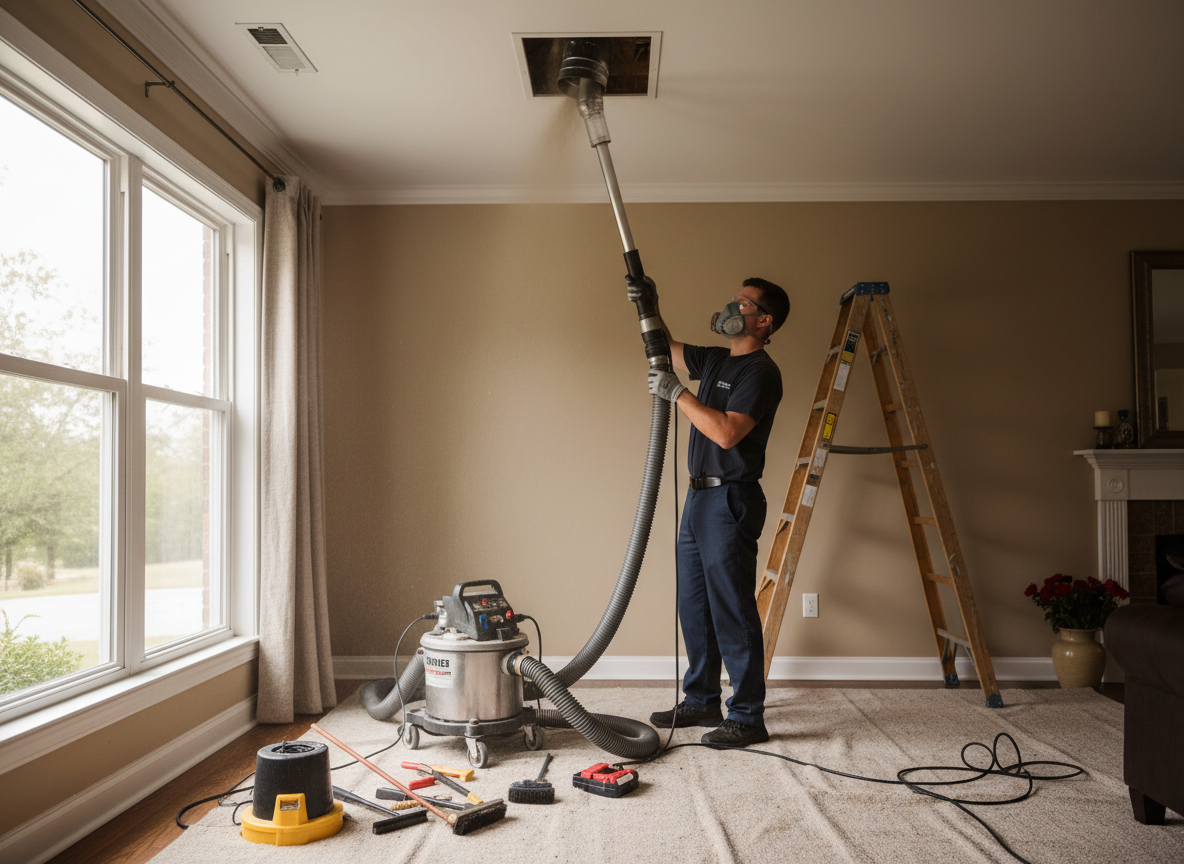
Montgomery's older housing stock near Court Square and along Montgomery Street often features ductwork installed decades ago that collects dust, pollen, and pet dander. Narrow crawl spaces and low attics common in these neighborhoods make full access difficult, so we use flexible whips and camera inspection to reach every run without tearing out walls. Seasonal humidity swings push moisture into metal ducts, creating conditions where mold can start on the interior lining if the system is not dried properly after cleaning.
We route our equipment through the parking lot behind Court Square Plaza Shopping Center so trucks do not block customer access during 24/7 calls. In single-story brick homes typical of the area, we isolate each branch run before agitation to keep debris from blowing back into living spaces. Nearby cities such as Prattville and Millbrook share the same red-clay soil that tracks in on shoes and eventually reaches return grilles, so we always pull the filters first and bag them on site.
Tree pollen from the live oaks around the plaza and along Perry Hill Road adds a sticky layer inside supply ducts during spring. We finish every job by wiping registers and vacuuming the immediate floor area so homeowners do not track material through the house after we leave. Because the work happens at all hours, we carry portable LED lighting and quiet vacuums to avoid disturbing neighbors in attached or close-set properties.
Technician insight
In Montgomery the thing that catches most people out with air duct cleaning near me is the narrow, low crawl spaces under 1960s brick homes near Court Square. You cannot drag a full-size vacuum through them, so the job takes longer and you have to work in sections or the debris just settles back into the returns.
Hidden debris in a Court Square home
A Montgomery homeowner called after noticing musty air when the system ran. We found years of accumulated dust and pollen packed in the return runs under the low crawl space. After isolating the system and using sectional whips, we extracted the material without disturbing the finished floors. The homeowner reported the air felt lighter within an hour of restart.
How it works
- 1
Initial Walk-Through
We inspect every accessible register and the furnace or air handler location to map the full duct layout before any equipment enters the home.
- 2
System Isolation
Registers are sealed and the main trunk is sectioned so debris cannot migrate into finished rooms during agitation.
- 3
Agitation and Extraction
Rotating brushes and compressed air move material to a HEPA-filtered vacuum connected at the nearest exterior access point.
- 4
Final Wipe and Verification
Registers and visible duct openings are wiped, filters are replaced if supplied, and a camera check confirms the runs are clear.
Pricing
Pricing depends on the number of runs, access difficulty in crawl spaces or attics, and whether the system has been neglected for multiple seasons.