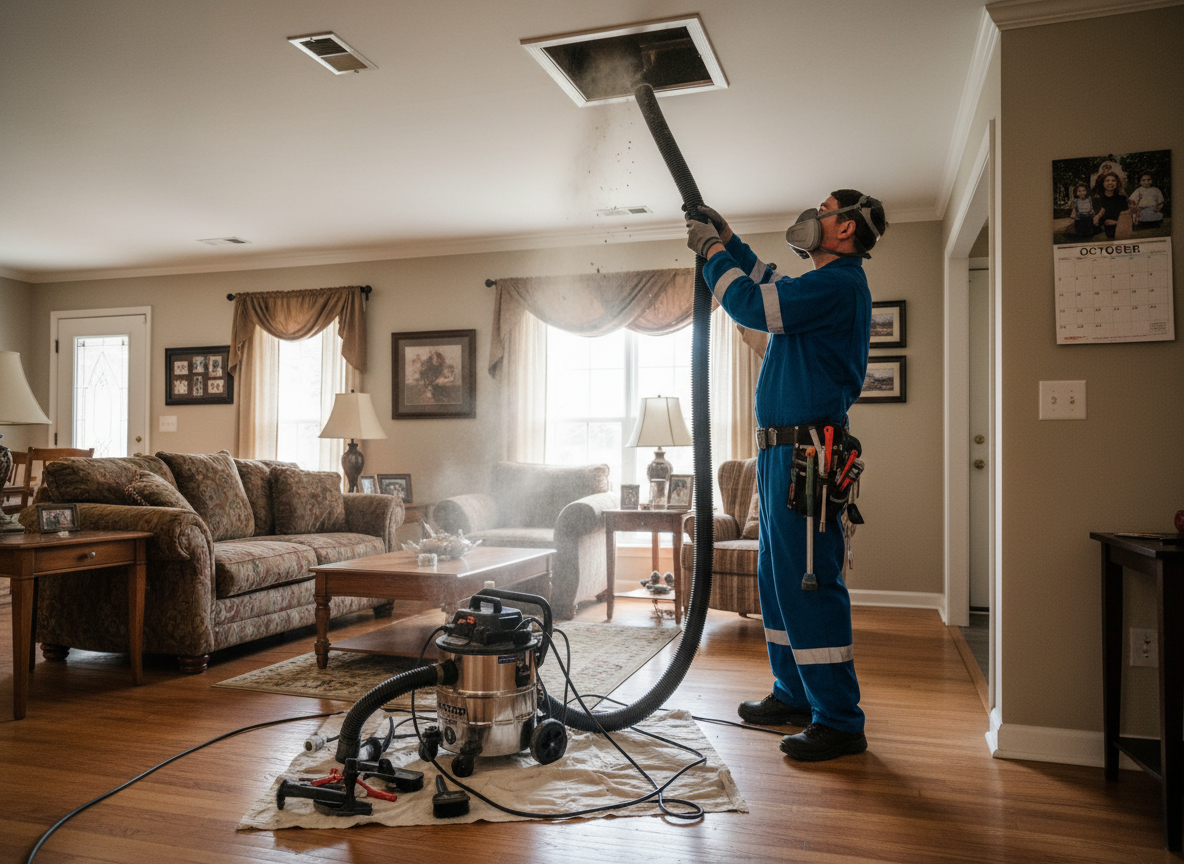
Montgomery sits in Hamilton County with many homes built between the 1950s and 1970s that still use original sheet-metal duct runs. These systems collect fine dust, pollen, and pet dander that the region's humid summers and cold winters push through registers during long heating and cooling cycles. Homeowners often notice uneven airflow or musty smells when the furnace kicks on after fall leaf season because settled debris blocks returns near the crawl spaces common in this terrain.
We pull registers, attach negative-air machines at the main trunk, and rod each branch line to break loose compacted material without damaging the thin metal joints found in older Montgomery houses. Special attention goes to the short, sharp turns near exterior walls where moisture from summer humidity can mix with dust and create stubborn buildup. After vacuuming, we wipe interior surfaces and reinstall registers so the system moves air evenly again.
Residents along Montgomery Road or near the Little Miami River corridor deal with extra pollen loads that standard filters miss. Our process includes a full visual check of accessible plenums because damaged insulation on ducts in unconditioned attics lets conditioned air leak and pulls in attic dust. This step prevents repeat service calls during the first cold snap when furnaces run nonstop.
We always test static pressure before and after to confirm the job restored proper flow rather than just removing visible dust. Homeowners in these neighborhoods appreciate the upfront walk-through that shows exactly which runs need extra time because of past renovations that rerouted ducts around finished basements.
Technician insight
In Montgomery the thing that catches most people out with Residential Air Duct Cleaning is the 1960s ranch homes along Weller Road where original ducts run through finished basements and any past moisture event leaves behind a sticky layer that standard brushes miss on the first pass.
Uneven airflow after furnace startup
A Montgomery homeowner called after noticing weak airflow from several registers once the furnace started running in October. We found compacted dust and leaf debris in the return lines near the crawl space that had built up over two seasons. After full agitation and extraction the system returned to balanced pressure and the musty smell disappeared.
How it works
- 1
Initial System Inspection
We examine every accessible duct section, register, and the furnace plenum to map the layout and note any damaged joints typical in Hamilton County homes.
- 2
Negative Air Setup
A sealed negative-air machine attaches at the main trunk while we close off returns to pull debris out without spreading it through living spaces.
- 3
Mechanical Agitation and Vacuuming
Rotary brushes and compressed-air whips loosen compacted material in each branch line, followed by continuous vacuum extraction until lines run clear.
- 4
Final Airflow Verification
We measure static pressure at multiple points and confirm even airflow before reinstalling registers and reviewing findings with the homeowner.
Pricing
Pricing varies by home size, number of runs, and access conditions in older Montgomery properties; we provide an upfront assessment before work begins.