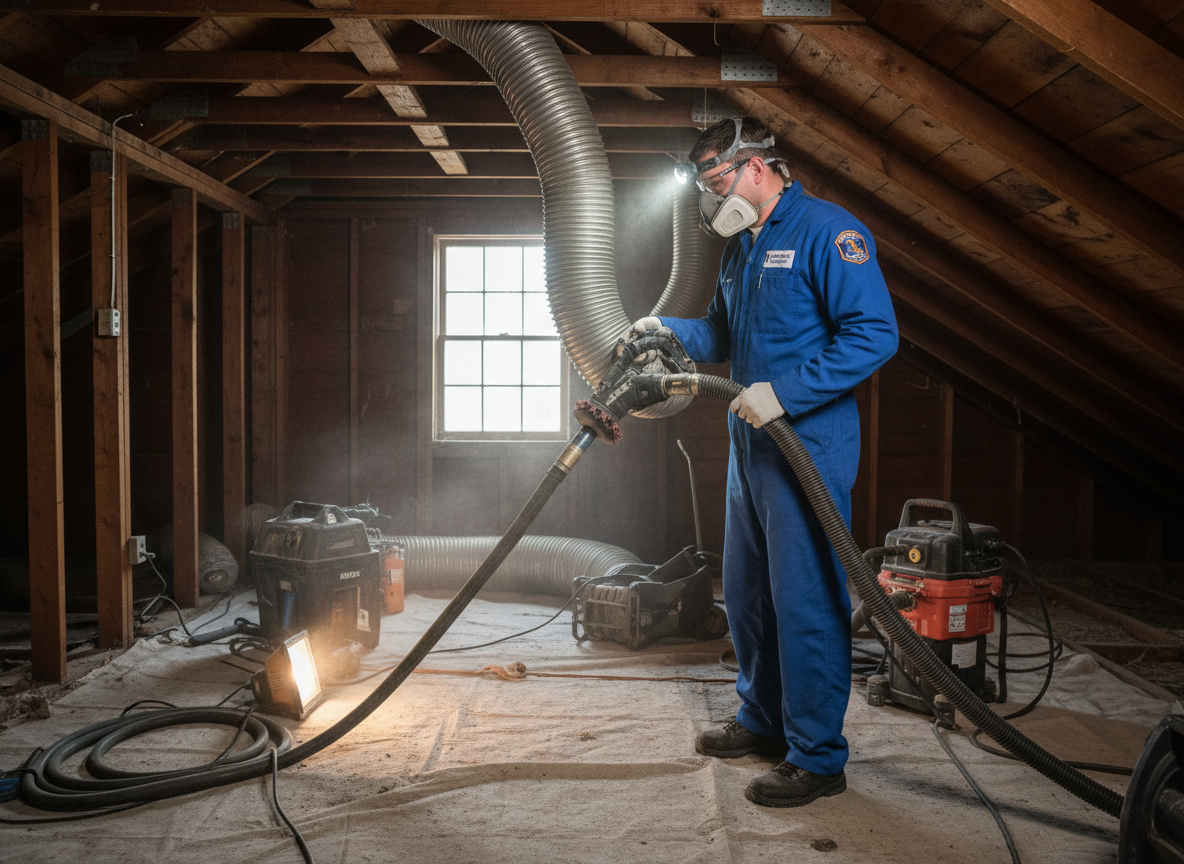
Montgomery's older neighborhoods around Court Square feature homes from the early to mid-20th century with narrow duct runs and multiple 90-degree bends that trap fine red clay dust. These systems often connect to central units installed in crawl spaces where soil moisture migrates upward during summer rains, creating sticky buildup that standard brushes miss. Technicians must disassemble register boots and use compressed air whips to reach the trunk lines without damaging the original sheet-metal seams.
High humidity in the Montgomery area keeps dust from drying out completely, so loose debris re-adheres to duct walls within weeks if not fully extracted. Homeowners near the Alabama River frequently report musty odors after heavy spring rains because water intrusion at slab edges pushes spores into the return plenums. Proper cleaning requires negative-air machines rated for the home's square footage plus manual agitation at each branch to prevent re-circulation during the next cooling cycle.
Technicians also check for disconnected flex runs common in additions added to 1950s bungalows, a frequent source of uneven airflow that cleaning alone cannot fix. Removing years of accumulated lint and construction debris from these lines improves static pressure and reduces strain on the blower motor, especially when outdoor temperatures push the system to run longer hours from May through September.
Technician insight
In Montgomery, the thing that catches most people out with local air duct cleaning is how the red clay soil and repeated foundation settling around Court Square shift duct joints just enough to let fine dust re-enter the system after every rain, so a single vacuum pass never finishes the job.
Court Square Bungalow Ducts
A 1948 bungalow near Court Square Plaza had weak airflow on the second floor. Inspection found disconnected flex at two elbows and heavy clay dust in the main trunk. Crew reconnected the runs, agitated and extracted the lines, then verified improved static pressure before leaving.
How it works
- 1
Initial Inspection
Technician enters the home through the Court Square Plaza area access and maps every supply and return run while noting access points and any disconnected sections.
- 2
Register and Boot Removal
All floor and wall registers are lifted, boots detached, and debris at the first elbow is manually collected before negative pressure is applied.
- 3
Agitation and Extraction
Rotary brushes and air whips loosen material while the vacuum draws it out; each trunk line is worked from the farthest register inward.
- 4
Final System Check
Registers are reinstalled, airflow is tested at multiple points, and the homeowner receives a written summary of findings and any recommended repairs.
Pricing
Cost depends on number of runs, access difficulty in older Montgomery homes, and whether flex duct repairs are needed; quotes provided after inspection.