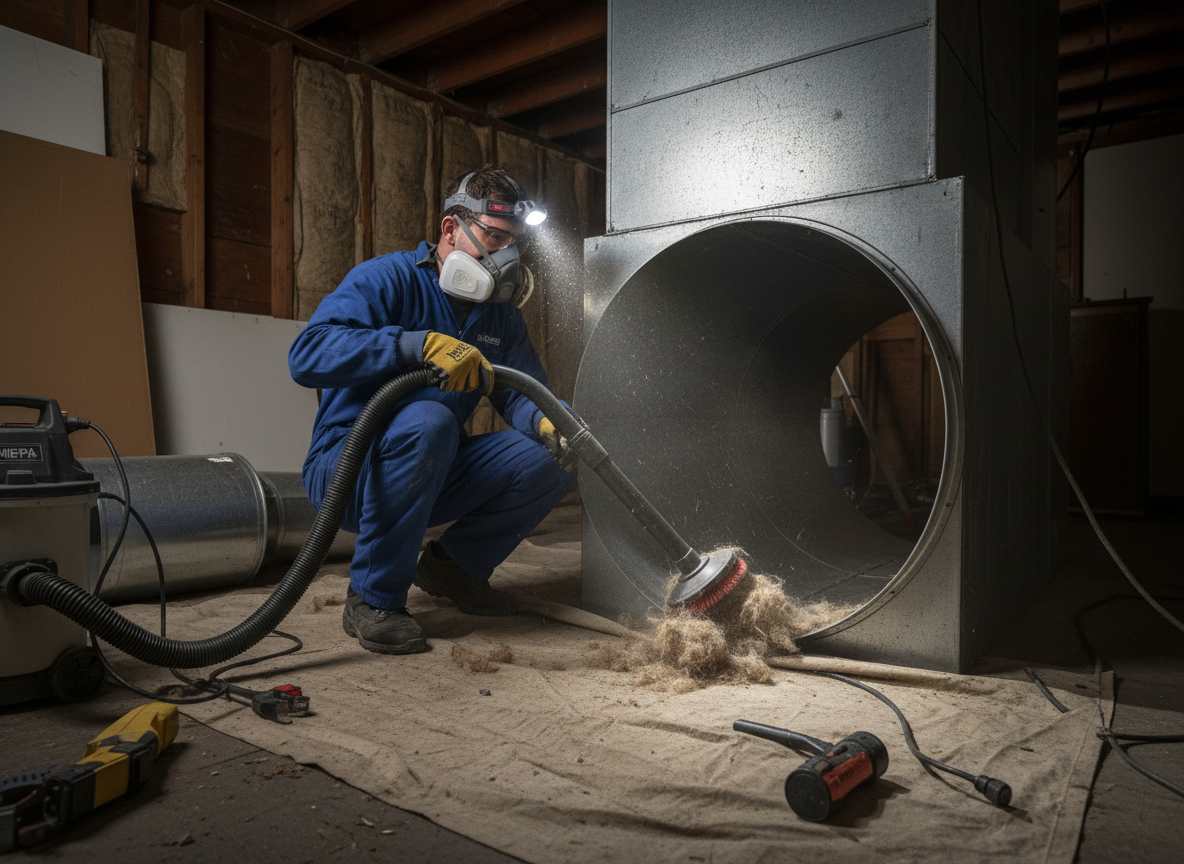
Pet hair and dander accumulate quickly in Montgomery homes because of the humid subtropical climate and older housing stock around Court Square and downtown. Fine hair travels through return vents and settles in flex ducts and trunk lines where standard filters miss it. Over time this restricts airflow, raises energy use, and recirculates allergens every time the system runs. Technicians must use brushes sized for narrow runs common in 1960s-1980s ranch houses and pull debris without tearing aged insulation.
High summer humidity in the Montgomery area combines with pet hair to create sticky mats that trap dust and encourage microbial growth inside metal ducts. Homeowners often notice musty odors or uneven cooling in upstairs bedrooms first. Proper cleaning requires negative-pressure machines placed at the main trunk plus access panels cut at strategic points so every branch receives agitation. Skipping these steps leaves hair lodged near registers that pets use as resting spots.
In neighborhoods near Court Square Plaza, narrow crawl spaces and low attic clearances limit equipment size. Technicians carry sectional rods and video scopes to inspect without major demolition. After agitation, HEPA vacuuming continues until airflow readings stabilize. Homeowners should replace or upgrade filters monthly afterward because residual hair continues shedding from carpets and furniture.
Technician insight
In Montgomery the thing that catches most people out with pet hair duct cleaning is the combination of older flex duct in 1970s homes near Court Square and our heavy summer humidity that turns loose hair into compacted mats inside the runs.
Pet Hair Restricting Airflow in Downtown Montgomery Home
A family with two large dogs noticed weak upstairs cooling. Inspection showed thick hair mats in the return trunk and flex lines feeding the bonus room. Sectional brushes and continuous negative pressure cleared the buildup. Airflow readings returned to normal and the musty smell disappeared.
How it works
- 1
Site Assessment
Inspect all accessible ducts, note pet traffic areas, and measure static pressure at the air handler.
- 2
Access Point Setup
Create entry points at the trunk and key branches while protecting flooring and walls.
- 3
Agitation and Extraction
Run rotating brushes and whips through each line while the vacuum maintains negative pressure.
- 4
Final Verification
Reconnect, test airflow, and walk the homeowner through before-and-after scope footage.
Pricing
Cost depends on square footage, number of pets, and duct accessibility; request an on-site assessment for an upfront quote.