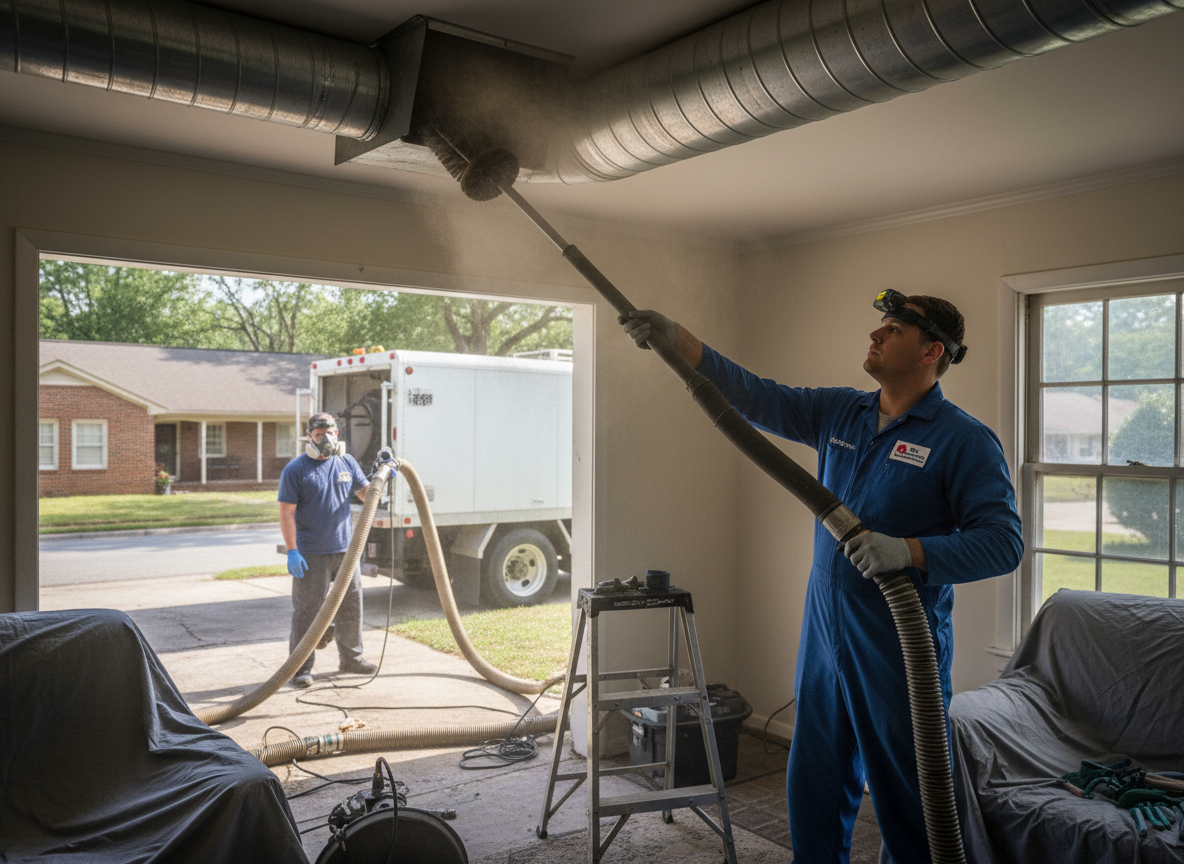
Whole house air duct cleaning in Montgomery requires accounting for the mix of pre-1970 brick homes near Court Square Plaza and newer subdivisions on the outskirts. Older duct runs often sit in crawl spaces or tight attics where Alabama humidity encourages dust and occasional microbial growth on fiberglass liners. Technicians must pull registers carefully to avoid damaging original plaster ceilings while using negative-air machines sized for the longer trunk lines common in these layouts.
Access points matter on jobs around Montgomery. Many homes have only one or two return grilles, so reaching every branch involves removing multiple supply boots and using whips or brushes on 6-inch flex runs that can kink if forced. Pet owners in the area frequently see heavier buildup on the first 10 feet of main trunk because central returns sit low and pull floor-level hair and dander year-round.
After cleaning, technicians seal seams with mastic rather than tape because summer temperature swings cause tape to loosen. Homeowners are shown the removed debris so they can judge whether future filter changes need to happen monthly during peak pollen seasons. Skipping this step in humid conditions often leads to rapid re-soiling within a single cooling season.
Technician insight
In Montgomery, the thing that catches most people out with whole house air duct cleaning is the combination of older plaster ceilings and high summer humidity that packs fine red-clay dust into the first few feet of every return. Homeowners often forget to change filters during the long cooling season, so the job always starts with extra time clearing the return plenum before the rest of the system can be addressed.
Return Plenum Blockage in Court Square Area Home
A 1960s brick house near Court Square Plaza showed weak airflow on the second floor. Inspection found the main return choked with years of fine dust and pet hair that had compacted against the coil. After removing the grille and clearing the first six feet of trunk, the remaining lines were agitated and extracted. Airflow returned to normal and the homeowner reported cooler rooms within two days.
How it works
- 1
Initial Walk-Through and Access Check
Technician inspects every register, return, and furnace location to map the full duct layout and note any damaged sections before equipment enters the home.
- 2
Negative-Air Setup and Register Removal
A HEPA-filtered vacuum is connected to the main trunk while all supply and return registers are removed and bagged to prevent cross-contamination during agitation.
- 3
Agitation and Extraction
Rotary brushes and compressed-air whips loosen debris along each branch; the negative-air machine pulls material out continuously until lines test clear.
- 4
Final Inspection and Reassembly
Each line is scoped again, registers are reinstalled with new foam gaskets, and the system is run to verify airflow and confirm no loose material remains.
Pricing
Cost depends on square footage, number of runs, and whether flex duct or lined sections need extra time; upfront quotes are provided after the walk-through.